Degree Three Ground Procedure
The InvincibleDegree Three Ground Procedure is the governing operational rule for the Invincible’s activity on Regis III, and its decisive significance is that it turns planetary exploration into a controlled system of shields, machines, personnel, and restricted movement. Introduced immediately after landing, it expresses both military caution and the expedition’s uncertainty: the crew cannot treat Regis III as an ordinary destination, so every step beyond the ship must be enclosed within procedures designed to preserve human life and maintain contact with the Invincible.
Adoption and Immediate Activation
No one aboard the Invincible expected the routine landing protocol to remain in force. When Rohan asked whether they would follow regular procedure, Horpach answered that they would begin with Degree Three Ground Procedure instead. Rohan tried to conceal his surprise, then announced the order to every deck in a voice still trembling with suppressed disapproval. The announcement directed the crew to prepare energobots, activate the shield batteries, send force-field technicians to their stations, and assume their assigned positions. Degree Three therefore began not as an abstract regulation but as a ship-wide mobilization that made the landing site a defended operational zone.
The procedure’s first visible result was the protective force field around the Invincible. As the field came into operation, large inforobots descended the ramp and spread through the gaps between the energobots, their antennae rotating as they took up defensive positions in the sand. The bridge instruments showed no attempt to penetrate the invisible barrier, while the power gauge climbed through successive gigawatt readings. The scene makes the rule’s logic concrete: safety depends on a distributed technical perimeter rather than on the ship alone.
Horpach then asked Rohan to oversee the standard procedure while he went below to eat. Rohan’s brief question about whether the commander meant to supervise remotely reveals how closely the protocol tied command responsibility to physical presence. Horpach allowed Rohan to send someone else or go down himself, but the procedure could not simply be left unattended. Even before the expedition had identified a specific enemy, Degree Three required continuous human oversight of the machines that protected the landing force.
Restrictions on Planetary Movement
The procedure imposed severe limits on what the expedition could investigate. When the coastline was estimated to be about 120 miles away, Horpach refused to move the Invincible and authorized Rohan to take as many men as necessary, including Fitzpatrick or another oceanologist and six reserve energobots. The order was explicit: the expedition was to operate exclusively within a force field, undertake no sorties onto the ocean, and carry out no diving. It also required the crew to conserve the automatons because their supply was limited. Degree Three thus defined exploration through prohibition as much as through permission.
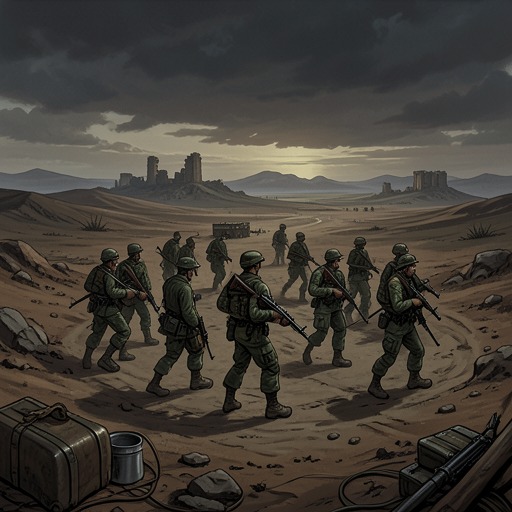
The commander also forbade travel by night. The ocean expedition consequently departed at five in the morning, before sunrise, in a formation known as a cortege. Two energobots at the front and rear generated an ellipsoidal force field enclosing the entire convoy: all-purpose hovercraft, jeeps carrying radio and radar equipment, a field kitchen, a transporter with self-assembling hermetic barracks, and a small direct-strike laser mounted on caterpillar tracks and informally called the punch. Rohan traveled with three scientists in the leading energobot, while the convoy moved only as fast as its slowest vehicles, which were the energobots.
This arrangement made the rule physically burdensome. The caterpillar tracks snarled across the sand, turbines whined, conditioned air blasted from the grates, and the energobot rocked like a heavy boat. The Invincible soon disappeared below the horizon, but the last vehicle remained in permanent radar contact with the ship. Even during movement, the expedition remained tethered to its base by communication, surveillance, and the protective field. The convoy could enter Regis III’s desert, but it could not become independent of the infrastructure that Degree Three had built around it.
Application to Scientific and Search Missions
Degree Three governed scientific investigation as well as military defense. The expedition crossed an apparently lifeless landscape, tested the water of a nearly dry creek, and continued through ravines and rocky basins while wearing oxygen masks. The procedure did not prevent observation; it made observation conditional upon protected access. The explorers could analyze the planet’s air, water, geology, ruins, and possible oceanic life, but their instruments and vehicles had to remain inside the field and within the convoy’s logistical structure.
After the teams began examining the ruins, the Condor, and the Western Desert, Horpach stated that Degree Three would continue in force. The decision to divide the work into three teams was itself constrained by the rule: even if vehicles from the Condor could be repaired, no more than fourteen energobots could be removed from the perimeter. The perimeter was therefore not expendable support. It was the condition that made any investigation possible, and weakening it threatened the entire operation.
The same principle shaped Rohan’s search for four missing members of Regnar’s team. His convoy consisted of two large energobots, four all-terrain caterpillar transporters, and a small amphibian craft carrying Rohan, Jarg, and Terner. The vehicles followed the configuration required by Degree Three: an empty energobot at the front, Rohan’s amphibian behind it, four two-man vehicles after that, and the second energobot at the rear. The two energobots enclosed the whole group within a force field while Rohan followed trails detected by olfactometric sensors and later tracked footprints into a ravine. The rule enabled a rescue mission in hostile terrain, but it also forced the search to proceed as a slow, visibly organized column rather than as a rapid pursuit.
Degree Three Against Regis III
The need for the procedure became clearer as the expedition reconstructed Regis III’s history. The planet appeared ancient, dry, and biologically divided: life remained in the ocean, while land organisms had disappeared millions of years earlier. Geological investigations found layers of ruddy-black, non-planetary metallic material, radioactive centers, and possible remnants of microscopic mechanisms. The evidence suggested that the desert was not simply empty but had been shaped by a long interaction between material processes and evolved machines.
The investigators eventually considered whether the metallic formations were inanimate products of evolution rather than a thinking civilization. One account held that such mechanisms were perfectly adapted to destroy intelligent or living organisms while lacking a strategic mind. Their attacks appeared opportunistic rather than coordinated, yet they could disperse, regenerate, multiply, obstruct radio communication, and evade the weapons that were lethal to biological life. Under this interpretation, Degree Three was not a temporary precaution against a conventional opponent. It was a boundary between vulnerable human bodies and a planetary system that could move freely outside the boundary.
The rule’s defensive geometry became especially important during the confrontation involving the Cyclops and the black mechanical cloud. The Invincible remained far from the epicenter while the engagement escalated into an antimatter strike. The explosion transformed the air, debris, steam, gases, and smoke around the Cyclops into hard radiation, and the resulting seismic waves rocked the Invincible forty miles away. Degree Three could protect the ship and the nearby personnel from many dangers, but it could not make violence local. The weapons used against the planet’s machines generated effects that traveled through the desert and reached the expedition’s infrastructure.
Ethical and Narrative Significance
Degree Three Ground Procedure embodies the expedition’s attempt to impose order on an environment that does not recognize human categories of enemy, organism, intelligence, or territory. Its force fields divide safe space from exposed space; its convoy arranges bodies, vehicles, sensors, weapons, and communications into a single operational organism; its limits on night travel, ocean access, diving, and the use of automatons translate uncertainty into rules. The procedure is rational, but its rationality is defensive rather than explanatory.
That distinction becomes ethically important when Horpach demands certainty before withdrawing. He will not return with hypotheses alone and wants samples of the flying mechanical fauna so that the expedition can establish what it is facing. Another view argues that the machines should be treated like a force of nature, not punished for the deaths of the Condor’s crew. The tension between these positions is also a tension within Degree Three itself: the protocol protects the expedition while enabling it to remain, investigate, and potentially escalate.
Rohan’s later reflections expose the cost of that persistence. He recognizes the absurdity of conquest at any cost and concludes that humanity had not yet earned the grand posture of galactocentrism if that posture meant understanding only beings like itself. In his revised understanding, Regis III’s metallic evolution had established its own equilibrium of survival over millions of years, and humans had no right to attack merely because its existence violated their expectations. Degree Three is therefore both a practical safeguard and a symbol of the expedition’s failure to decide whether protection should serve knowledge, survival, or withdrawal.
The rule’s deepest irony is that it makes disciplined movement possible while preserving the illusion of control. The crew can activate shields, arrange energobots, maintain radar contact, and regulate every expedition, yet the planet’s processes remain larger than the procedure. Degree Three keeps humans alive long enough to discover that the threat may not be an intentional adversary at all, and that technical superiority does not confer ownership. Its final significance lies in that contradiction: the protocol is necessary for entering Regis III, but the knowledge gained under its protection points toward the necessity of leaving the planet rather than mastering it.